7 Best AI Chatbots for Restaurants in 2026 - Compared
-
02 Jul 2026
-
3661 Views
7 Best AI Chatbots for Restaurants in 2026 (Menu, Orders, Reservations)
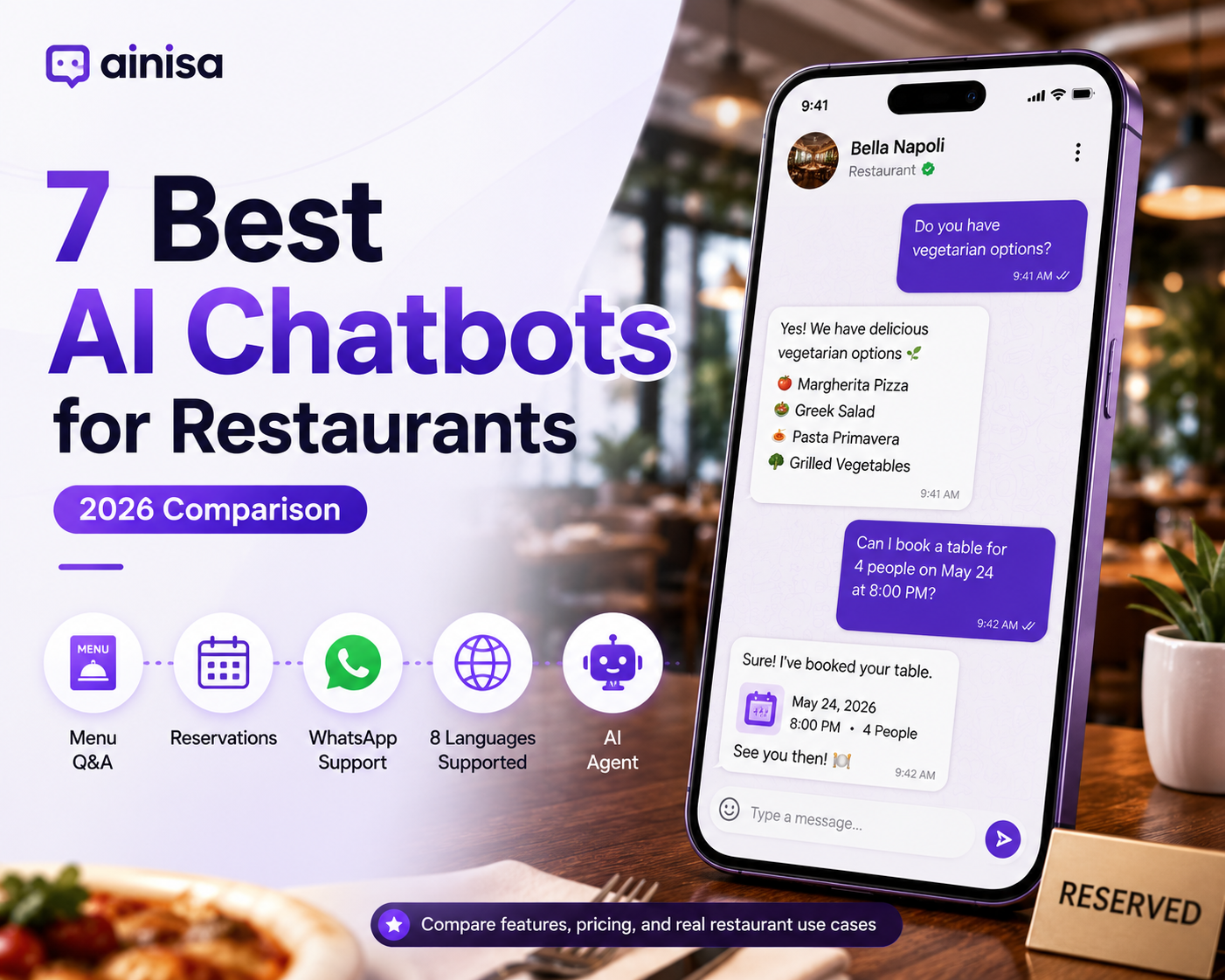
Running a restaurant in 2026 means answering the same 30 questions every night: "Are you open?" "Do you have vegetarian options?" "Can I book a table for 4 at 8pm?" "Do you deliver?" Most of those messages hit WhatsApp, Instagram, or the website — often while your team is plating orders.
AI chatbots have finally caught up with restaurant reality. They handle menu questions, take reservations, push food orders straight to Google Sheets or your CRM, and stay online 24/7 without adding staff. But most "restaurant chatbot" lists mix outdated pricing with generic e-commerce tools that were never built for hospitality.
We tested 7 AI chatbots specifically for restaurant use cases in 2026 — menu Q&A, table reservations, food ordering, WhatsApp deployment, and multilingual tourist support. Here's what actually works.
TL;DR — Quick Comparison
| # | Tool | Best For | Starting Price | AI-Native | Multilingual | |
|---|---|---|---|---|---|---|
| 1 | Ainisa | Multi-channel, multilingual restaurants with BYOK | $25/mo annual, $39/mo monthly | ✅ Native | ✅ Meta Partner | ✅ 8 languages |
| 2 | Chatfuel | Meta-first restaurants (IG + WhatsApp) | $49/mo AI Pro (free tier avail) | ⚠️ AI Pro tier | ✅ Meta Partner | Limited |
| 3 | Tidio | Website-first restaurants with Shopify | $29/mo + Lyro AI add-on | ⚠️ Lyro add-on | ✅ | Limited |
| 4 | Chatbase | Website FAQ + menu Q&A only | Hobby $32/mo annual, $40 monthly | ✅ | ⚠️ via integration | ✅ |
| 5 | ChatBot.com | Enterprise chains on LiveChat ecosystem | $65/mo Starter | ⚠️ Rules + AI hybrid | ⚠️ Extra cost | Limited |
| 6 | Voiceflow | Restaurants with in-house dev team | Pro $60/editor + credits | ✅ | ✅ (build-your-own) | ✅ |
| 7 | Botsonic | Cheap website FAQ bot | Starter $16/mo annual, $19 monthly | ✅ | ⚠️ via integration | ✅ 95+ langs |
Winner for most SMB restaurants: Ainisa (see #1). If you're 100% Meta-first (IG/WhatsApp DMs): Chatfuel. If you have a dev team: Voiceflow.
How We Picked
We evaluated each tool against 6 criteria specifically for restaurants:
- Menu Q&A accuracy — Can it answer "Do you have gluten-free?" without hallucinating? Requires proper RAG (retrieval-augmented generation), not just prompt injection.
- Reservation booking — Does it capture table reservations and route them to your calendar, CRM, or a simple Google Sheet? Can it handle party size, date, time, and special requests?
- Food ordering — Can guests order from the menu inside chat, with items collected and pushed to staff? Or does it just redirect them to a delivery app?
- WhatsApp Business API — Real WhatsApp integration (not just Business App) so you get message templates, verified badge, and no personal SIM tied to your restaurant.
- Multilingual — Restaurants serve tourists. A chatbot that only speaks English is leaving conversions on the table in cities like Baku, Barcelona, Istanbul, or Berlin.
- True monthly cost — Not the sticker price. What you actually pay at 500–2,000 conversations/month, including hidden AI conversation limits, editor seat fees, and WhatsApp template fees from Meta.
1. Ainisa — Best Overall for SMB Restaurants
Best for: Restaurants that need one AI agent across website, WhatsApp, Instagram, Facebook, Telegram, and TikTok — in up to 8 languages — with menu Q&A, table reservations, and food ordering all handled inside chat.
Pricing: Pro $25/mo (annual) or $39/mo (monthly) — 2 agents, 3,000 messages/month, custom forms, custom APIs, appointment booking, lead generation. Growth $79/mo (annual) or $119/mo (monthly) — 5 agents, 10,000 messages, ideal for multi-location restaurants. Team $159/mo (annual) or $199/mo (monthly) — 10 agents, 50,000 messages. On Premise available.
Free trial: Yes, no credit card required.
Ainisa is built specifically for SMBs in appointment and reservation-based verticals — restaurants, dental clinics, salons, education, consulting. The restaurant use case ships with a pre-built agent that handles menu questions and pricing, opening hours and location, table reservations, food ordering, delivery and pickup info, FAQs, staff handoff, and demo leads stored in Google Sheets.
The RAG (Retrieval-Augmented Generation) system runs on hybrid dense and sparse vectors. Upload your menu as a PDF in any of 8 languages (English, Azerbaijani, Russian, Turkish, German, French, Spanish, Chinese) and the agent answers "do you have vegetarian options?" or "how much is the lamb kebab?" straight from your actual menu — not a hallucination.
Pros:
- True 6-channel deployment from one dashboard — website, WhatsApp Business API, Facebook Messenger, Instagram, Telegram, TikTok. Most competitors handle 2–3 channels.
- BYOK (Bring Your Own Key) — connect your own OpenAI, Anthropic, or Gemini API key and pay AI providers at cost. Chatfuel, Tidio, and Chatbase mark up AI usage 2–4x by bundling it into subscription tiers.
- 8 languages native — critical for restaurants serving tourists; you upload the menu once per language, no separate flows needed.
- Official Meta Technology Partner — full WhatsApp Business API access, green verified badge available.
- Reservations and food orders built in — leads flow to Google Sheets by default; can route to Telegram groups, email, CRM, or webhooks for production.
- SOC 2 aligned, GDPR ready — enterprise compliance built in.
- Live demo agent you can chat with right now on the restaurant use case page — try it in any of 8 languages.
- Purpose-built for hospitality-style workflows — same platform also powers dental clinics, medical clinics, beauty salons and spas, education centers, and consulting services.
Cons:
- BYOK requires you to set up API keys yourself — a 3-minute copy-paste from OpenAI, but non-technical users may prefer bundled AI.
- Smaller brand awareness than Chatfuel or Tidio — a newer entrant, though 50+ restaurants and clinics in production.
- No native voice or phone channel yet — if you need AI to answer phone calls for reservations, Voiceflow is currently the better fit.
Verdict: For a single-location or multi-location restaurant that wants everything — menu Q&A, reservations, orders, multilingual, multi-channel — from one tool without AI markup, Ainisa is the strongest all-around fit. Try the live restaurant demo agent — chat with it about a real Turkish kebab menu in English, Russian, German, Spanish, French, or Chinese.
2. Chatfuel — Best for Meta-First Restaurants
Best for: Restaurants running everything through Instagram DMs, Facebook Messenger, and WhatsApp — no website chat needed.
Pricing: Chatfuel Light is free (Instagram, Facebook, WhatsApp automations with shared inbox and flow builder). AI Pro at $49/mo (or $35/mo annually with -29% discount) adds the AI sales manager, AI knowledge base, AI-powered automations, broadcasts, and funnels for lead qualification.
Free trial: Yes, Chatfuel Light is free forever; AI Pro has a trial.
Chatfuel powers roughly 46% of all Messenger bots and is a Meta Business Partner. Their Fuely AI engine handles menu FAQs, lead capture, and reservation intake across IG, Messenger, WhatsApp, and TikTok DMs.
Pros:
- Very fast to launch on IG and WhatsApp.
- Meta Business Partner — smoother WhatsApp Business API onboarding.
- Free tier (Chatfuel Light) is genuinely usable for basic automations.
- Strong flow builder if you want structured booking funnels.
Cons:
- No website chat widget — if you also want a bot on your website, you'll need a second tool.
- AI is behind a paywall — the free plan is flow-based only; real AI understanding requires AI Pro at $49/mo.
- WhatsApp template fees from Meta are on top — $0.005–$0.08 per conversation depending on country and type.
- Cannot merge contacts across channels — same customer on IG and WhatsApp = two separate contacts.
- No native multilingual support — you'd build separate flows per language.
Verdict: Solid if your restaurant is 100% Meta-first and website chat isn't needed. If you serve tourists in multiple languages or want a website widget, you'll outgrow it.
3. Tidio — Best for Website-First Restaurants with Shopify
Best for: Restaurants that sell heavily through Shopify (delivery kits, merch, gift cards) and want website chat as the primary channel.
Pricing: Starter $29/mo (100 billable conversations), Growth $59/mo (from 250 billable conversations), Plus starts at $749/mo, Premium custom (~$2,999/mo). Lyro AI is a separate add-on — 50 Lyro conversations included one-time on Starter/Growth; more require paid Lyro packages.
Free trial: 7 days full access, then free plan with 50 conversations.
Tidio is website-chat-first with strong Shopify integration. Lyro (their AI agent) can be trained on your menu and FAQ pages, and Tidio supports WhatsApp, IG, and Facebook as additional channels.
Pros:
- Excellent Shopify integration for restaurants with e-commerce.
- Clean UI, easy to train Lyro on menu content.
- Good live-chat-to-human handoff.
- Free plan lets you test basic setup.
Cons:
- AI is a paid add-on — the $29 Starter is live chat only. Lyro AI packages are billed separately, so real cost for a small restaurant with real AI usage is $80–150/mo.
- Volume pricing traps — at 95% of your conversation quota, Tidio auto-upgrades you to the next tier. Bills can jump $25–$700 in a single month.
- December 2024 pricing changes doubled bills for some existing customers per multiple third-party reports.
- Big pricing gap between Growth ($59) and Plus ($749) with nothing in between.
- 10-agent seat cap on all plans except the $749/mo Plus tier.
- Limited multilingual — you can add languages, but the AI training is optimized for English.
Verdict: Fine if you're already a Shopify shop and website chat is your priority. Otherwise, the add-on pricing makes total cost hard to predict.
4. Chatbase — Best for Simple Menu Q&A Only
Best for: Small restaurants that want a website FAQ bot that answers "what are your hours?" and "do you have gluten-free?" — nothing more.
Pricing: Free (50 credits, 1 agent, deleted after 14 days inactivity). Hobby $40/mo monthly or $32/mo annual (500 message credits, 1 agent). Standard $150/mo monthly or $120/mo annual (4,000 credits, 2 agents). Pro $500/mo monthly or $400/mo annual.
Free trial: No trial for premium features — only the limited Free tier.
Chatbase focuses on training a website chatbot on your data (PDFs, URLs, Notion pages). Very fast setup — upload menu PDF, embed on your site, done in 15 minutes.
Pros:
- Fastest setup — upload menu PDF, done.
- Choice of AI models (GPT-4o, Claude, Gemini, DeepSeek, Llama).
- Good analytics on chat logs and confidence scores.
- AI Actions can call APIs (booking meetings, etc.).
Cons:
- Credit-based pricing punishes success — premium models consume 3–5x more credits. Overages at $12–14 per 1,000 credits.
- Custom domain is $59/mo add-on, branding removal $39–99/mo.
- No native WhatsApp Business API — only via Zapier and integrations.
- Missing human handoff — if AI can't answer, the conversation just ends.
- No native reservation booking or food-order flow — you'd build it via AI Actions manually.
- Agent deleted after 14 days of inactivity on the free plan.
Verdict: Great as a website menu FAQ widget. Not a full restaurant chatbot solution.
5. ChatBot.com — Best for Enterprise Restaurant Chains
Best for: Multi-location restaurant chains or franchises that need enterprise-grade routing, integrations, and live chat, especially if you're already on LiveChat.
Pricing: Starter $65/mo (1,000 valid chats), Team $169/mo, Business $499/mo. AI Assist add-on billed separately.
Free trial: 14 days.
ChatBot.com (by LiveChat, Inc.) is a mature, enterprise-oriented platform with strong live chat, routing, and multi-agent tools. Best if you already use their LiveChat product.
Pros:
- Enterprise-grade uptime and support.
- Deep LiveChat ecosystem integration.
- Solid rules engine for structured booking flows.
- Reliable at scale (thousands of concurrent chats).
Cons:
- Expensive for small restaurants — $65/mo entry is 2x competitors for less AI.
- Hybrid rules and AI, not AI-native — feels older than 2026 tools like Ainisa or Chatbase.
- WhatsApp requires extra setup and cost.
- Limited multilingual — separate flows per language.
Verdict: Overkill for a single restaurant. Makes sense for chains with 20+ locations already on LiveChat.
6. Voiceflow — Best for Restaurants with In-House Developers
Best for: Larger restaurant groups with a dev team that wants to build a highly custom AI agent with full control over LLM prompts, function calls, and integrations — especially if voice-ordering (phone lines) is a priority.
Pricing: Starter free (100 credits/mo, 1 editor, 2 agents — testing only). Pro $60/mo per editor (10,000 credits, 20 agents, GPT-4 and Claude access). Business $150/mo per editor (30,000 credits, unlimited agents). Additional editor seats $50/mo each on Pro and Business. Enterprise custom.
Free trial: Yes, free Starter plan available.
Voiceflow is the developer-friendly choice for building agentic AI experiences — great for voice and chat combos, complex multi-turn conversations, and deep API integrations.
Pros:
- Full control over LLM behavior, prompts, and knowledge base.
- Excellent for voice ordering (phone lines) alongside chat.
- Robust dev tools, function calling, version control.
- Multichannel: web, WhatsApp, voice, SMS.
- G2 2026 Best Software Award winner.
Cons:
- Steep learning curve — you need someone technical to build and maintain.
- Per-editor pricing scales fast — a 5-editor team on Business = $350/mo before credit overages.
- Credit system creates unpredictability — hit your monthly limit and agents stop responding until renewal; no mid-cycle top-ups on lower tiers.
- BYO LLM (own OpenAI key) is Enterprise-only — cheaper tiers can't bring their own key.
- Phone and voice adds telephony costs — Twilio or Vonage at $0.01–0.03 per minute.
- No pre-built restaurant template — you're building menu Q&A logic yourself.
Verdict: Best-in-class if you have engineering resources and want voice and chat combined. Skip if you're a busy restaurant owner who wants a working bot next week.
7. Botsonic — Best for Low-Budget Quick Setup
Best for: Solo restaurant owners who want a cheap website chatbot in under an hour, with no booking or ordering features required.
Pricing: Starter $16/mo annual ($19 monthly) — 1 chatbot, 1,000 messages, 10M uploaded characters, 3 Agentic Actions. Professional $41/mo annual ($49 monthly) — 2 chatbots, 3,000 messages, 50M characters, 5 Agentic Actions. Advanced $249/mo annual ($299 monthly) — 12,000 messages, 100M characters.
Free trial: 7-day free trial on paid plans.
Botsonic (by Writesonic) is a lightweight AI chatbot builder focused on quick FAQ-style deployments. Upload content, get an embed code, done.
Pros:
- Cheapest entry point at $16–19/mo.
- Fast setup with URL scraping and PDF upload.
- Multilingual (95+ languages via GPT models).
- Agentic Actions for basic API calls.
Cons:
- No native booking or reservation flow — you'd redirect to a booking page.
- WhatsApp only via Zapier and integrations — no native Business API.
- Message-based pricing can be unpredictable at high volume — only 1,000 messages on Starter.
- No behavioral modes or state detection — the bot answers questions but doesn't adapt to conversation type.
Verdict: Fine as a super-cheap website FAQ bot. Won't handle real restaurant workflow with reservations and orders.
Side-by-Side Feature Matrix
| Feature | Ainisa | Chatfuel | Tidio | Chatbase | ChatBot.com | Voiceflow | Botsonic |
|---|---|---|---|---|---|---|---|
| Starting price | $25–39 | Free / $49 AI | $29 + AI | $32–40 | $65 | $60 + credits | $16–19 |
| Native WhatsApp API | ✅ | ✅ | ✅ | ⚠️ | ⚠️ | ✅ | ⚠️ |
| ✅ | ✅ | ✅ | ❌ | ❌ | ⚠️ | ❌ | |
| Website widget | ✅ | ❌ | ✅ | ✅ | ✅ | ✅ | ✅ |
| Menu Q&A (RAG) | ✅ | ⚠️ AI Pro | ✅ Lyro | ✅ | ⚠️ | ✅ | ✅ |
| Table reservations | ✅ | ⚠️ | ⚠️ | ⚠️ | ✅ | ✅ | ❌ |
| Food ordering | ✅ | ⚠️ | ⚠️ | ❌ | ⚠️ | ✅ | ❌ |
| 8+ languages native | ✅ | ❌ | ⚠️ | ✅ | ⚠️ | ✅ | ✅ |
| BYOK (own AI keys) | ✅ | ❌ | ❌ | ❌ | ❌ | ⚠️ Enterprise | ❌ |
| No-code setup | ✅ | ✅ | ✅ | ✅ | ✅ | ❌ | ✅ |
| Meta Business Partner | ✅ | ✅ | ❌ | ❌ | ❌ | ❌ | ❌ |
| Lead delivery (Sheets/CRM/webhook) | ✅ | ⚠️ | ⚠️ | ⚠️ | ✅ | ✅ | ⚠️ |
| SOC 2 alignment | ✅ | ⚠️ | ✅ Plus | ⚠️ | ✅ | ✅ | ⚠️ |
Which One Should You Choose?
Single-location restaurant serving tourists in multiple languages → Ainisa. Multi-channel, 8 languages, BYOK keeps AI costs at cost, reservations and orders and menu Q&A built in.
100% Meta-first (IG + WhatsApp only), no website chat → Chatfuel. They own the Meta ecosystem.
Shopify-heavy restaurant with strong website e-commerce → Tidio. But budget for the Lyro AI add-on, not just the base plan.
Just a menu FAQ bot on your website, nothing fancy → Chatbase or Botsonic.
Chain of 20+ restaurants already on LiveChat → ChatBot.com.
Dev team building custom voice and chat agents → Voiceflow.
Frequently Asked Questions
What's the best AI chatbot for a restaurant in 2026?
For most SMB restaurants, Ainisa is the best all-around choice — it handles menu Q&A, reservations, and food ordering across website, WhatsApp, Instagram, Facebook, Telegram, and TikTok in 8 languages, starting at $25/mo annually with BYOK (no AI markup). Chatfuel is a strong runner-up if you only need Instagram and WhatsApp.
What's the cheapest AI chatbot for a small restaurant in 2026?
Botsonic at $16/mo annually is the cheapest entry point for a website-only FAQ bot. For a real restaurant workflow with reservations, food orders, and WhatsApp, Ainisa's Pro plan at $25/mo annual (or $39/mo monthly) is the best price-to-capability ratio.
Do AI chatbots really reduce restaurant no-shows?
Yes. Chatbots that send reminders 24 hours and 2 hours before a reservation typically reduce no-shows by 25–40% based on hospitality industry reports. Most no-shows are forgotten reservations, not intentional.
Can a chatbot take food orders directly on WhatsApp?
Yes, but only if it supports WhatsApp Business API (not the regular Business App). Ainisa, Chatfuel, and Voiceflow support this. The bot shows the menu, collects the order, and pushes it to your Google Sheet, Telegram group, email, CRM, or webhook.
What languages should my restaurant chatbot support?
At minimum, your primary language plus English for tourists. In tourism-heavy cities (Baku, Barcelona, Istanbul, Berlin, Dubai), 4–6 languages significantly boost conversion. Ainisa supports 8 languages natively; most competitors require separate flows per language.
How long does it take to set up a restaurant chatbot?
Menu Q&A only: 30 minutes to 2 hours. Full setup with reservations, WhatsApp Business API, and food ordering: 4–8 hours if your menu is ready. Ainisa and Chatbase are fastest for menu Q&A; Voiceflow is slowest but most powerful.
Do I need WhatsApp Business API, or is the regular WhatsApp Business App enough?
For a real chatbot, you need the API. The App is designed for humans replying manually. The API supports templates, verified green badge, and high message volumes. Any Meta Business Partner (Ainisa, Chatfuel) can help you onboard in 1–3 days.
How much does WhatsApp itself cost on top of the chatbot?
Meta charges per conversation, not per message. Service conversations are $0.005–$0.03 depending on country; marketing conversations $0.02–$0.08. For a typical restaurant with 500 monthly conversations, expect $10–25/mo in Meta fees on top of your chatbot subscription.
Can chatbots integrate with my existing POS or reservation system?
Depends on the tool. Ainisa integrates with Google Sheets natively for demos, plus Telegram, email, CRM, and webhooks for production. Voiceflow can connect to any API via function calling but requires dev work. Chatfuel connects via Zapier. For POS integration (Square, Toast, Lightspeed), Voiceflow and Ainisa are the most flexible.
What's BYOK (Bring Your Own Key) and why does it matter for restaurants?
BYOK means you provide your own OpenAI, Anthropic, or Gemini API key and pay the AI provider directly. Platforms like Ainisa use BYOK, so AI costs are at-cost (no markup). Chatfuel, Tidio, and Chatbase mark up AI usage 2–4x by bundling it into subscription tiers. For a busy restaurant with 2,000+ monthly conversations, BYOK can save $50–200/mo.
What happens after office hours — does the chatbot still work?
Yes, that's the point. All 7 tools work 24/7. This matters because guests search for restaurants during evenings, weekends, and holidays — exactly when your team is busy or offline. A restaurant that captures a reservation at 11pm on a Saturday would otherwise lose that guest to a competitor.
Ready to see one in action?
The fastest way to evaluate any of these tools is to actually chat with a live demo agent.
Try Ainisa's Restaurant AI Agent live — menu Q&A on a real Turkish kebab menu, table reservations, and food ordering, with Google Sheets lead delivery you can view directly:
Available in English, Azerbaijani, Russian, Turkish, German, French, Spanish, and Chinese. SOC 2 aligned, GDPR ready.
Not just for restaurants — Ainisa also powers AI agents for: