WhatsApp Chatbot for Dental Clinics: 2026 Setup Guide
-
21 Jul 2026
-
2134 Views
How Dental Clinics Set Up WhatsApp Chatbots for Appointments, Insurance Intake, and Patient Media (2026 Guide)
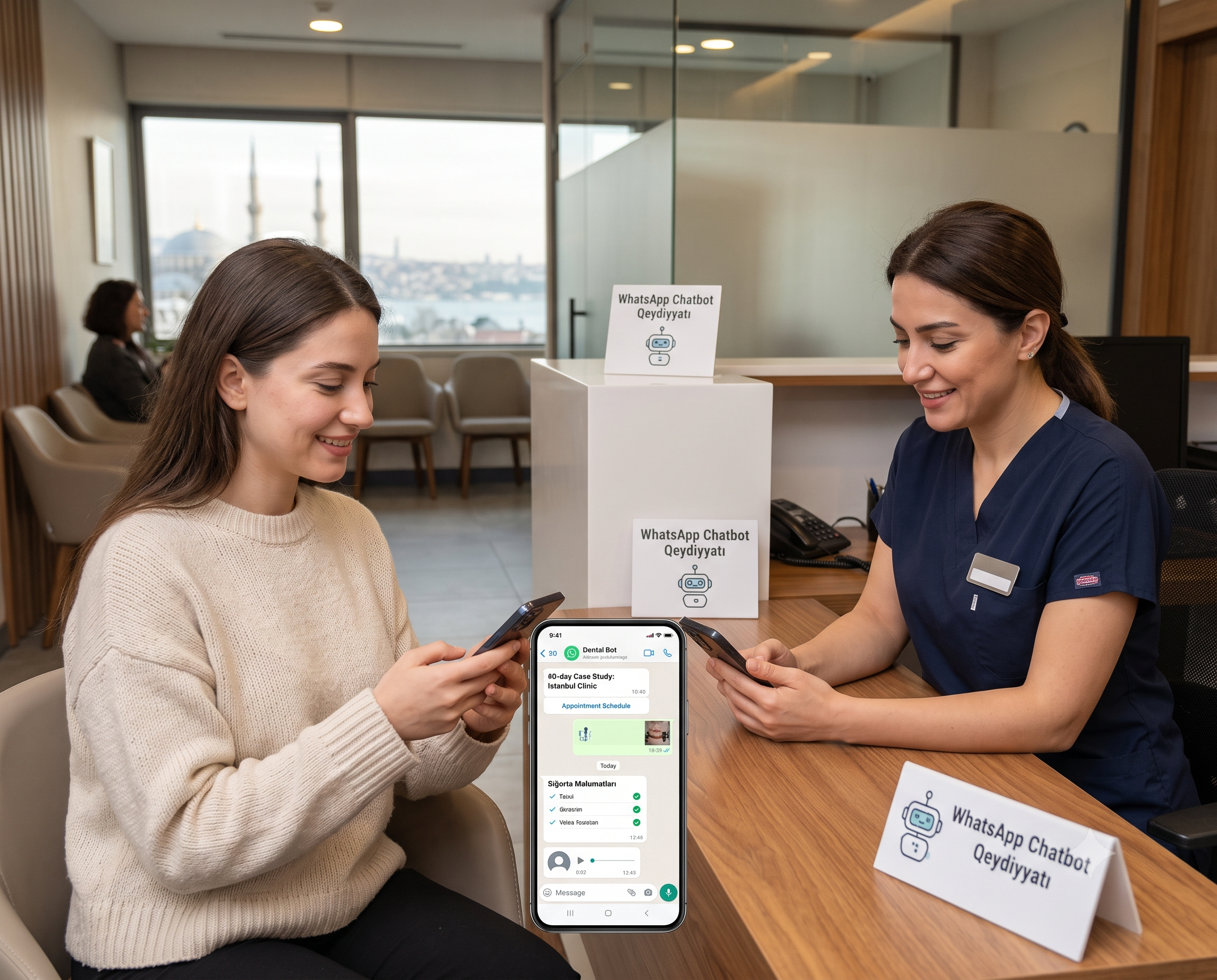
Dental clinics outside the US primary market lose an average of 25% of appointment slots to no-shows, phone tag, and unanswered messages. In 2026, a growing share of that leak is fixable — with a WhatsApp chatbot that books cleanings and consultations directly, syncs with Google Calendar or your PMS, and understands more than just text: voice notes, photos of broken teeth, and videos patients send after hours.
Most dental practice managers know they should be on WhatsApp. What they don't know is how to get there without creating a compliance mess, without the bot pretending to be a dentist, and without spending three months on integration.
This guide walks through exactly how private dental practices, orthodontic clinics, cosmetic dental groups, and dental tourism practices deploy a working WhatsApp chatbot in 2026 — from Business API onboarding through insurance intake flows, Google Calendar sync, multi-modal media handling (voice notes, photos, videos), and the five dental-specific safety boundaries that separate a professional deployment from a licensing board complaint.
By the end, you'll know what to build, what to avoid, and what a real 90-day rollout looks like.
Who this guide is for
This guide is written for dental practices where:
- Patients pay cash, out-of-network, or private insurance (not US Medicare/Medicaid)
- The practice doesn't sign HIPAA Business Associate Agreements as a matter of workflow
- WhatsApp is the primary or secondary patient contact channel
- The practice has one to ten providers and books appointments (not walk-in only)
This includes private dental practices, orthodontic practices, cosmetic dental groups, oral surgery practices, dental practices in the EU/UK/CH, and dental SMBs across LATAM, MENA, Turkey, and Asia — especially dental tourism markets.
If you're a US practice heavily processing PHI under HIPAA and want a signed BAA, this guide is not for you — evaluate US dental-specific platforms like Weave, NexHealth, or Solutionreach instead. Most dental practices handle less PHI than primary care, but always verify your workflow.
Why WhatsApp is the real patient channel outside the US
Three shifts made 2026 the year dental practice managers actually deploy WhatsApp bots instead of talking about them.
Patients moved off the phone. A 2025 healthcare survey across Turkey, Spain, Mexico, and the UAE found 68% of appointment inquiries now start as a WhatsApp message. Dental practices still routing everything through a landline are losing bookings to the practice two doors down that answers in WhatsApp in under two minutes.
WhatsApp Business API is fast now. Getting API access used to take a week of paperwork through Twilio or another intermediary. In 2026, connecting through a Meta Business Partner takes about 5 minutes of technical setup, plus 24 to 48 hours for Meta's business verification and message template approval. That's it.
AI got multi-modal. This is the shift that matters most for dental. In 2024, an AI chatbot could only read text messages. In 2026, modern platforms understand voice notes up to 5 minutes long, photos of broken crowns or swollen gums, and videos up to 60 seconds — in any of the 8 languages a Meta Business Partner platform like Ainisa supports. A patient can send a voice note in Turkish saying "I lost a filling this morning, can I come in tomorrow?" and the bot transcribes it, understands intent, checks the calendar, and books the appointment — no typing required.
For dental specifically, this changes everything. Roughly a third of after-hours dental inquiries now come as voice notes or photos, not text. Practices that can only process text miss all of them.
What a WhatsApp chatbot actually does for a dental practice
A modern dental practice chatbot handles eight concrete tasks:
- Appointment booking — patient name, phone, procedure type (cleaning, filling, extraction, whitening, orthodontic consultation), preferred provider, date and time, insurance status, sent into Google Calendar, Calendly, or your PMS
- Procedure and pricing questions — trained on your service list PDF, answers "what does teeth whitening cost?" and "how long is an implant consultation?" with real numbers
- Insurance intake — collects insurance provider, policy number, and out-of-network status before the visit, saving front desk 5-10 minutes per patient
- Multi-modal media handling — processes voice notes (up to 5 minutes), photos, and videos (up to 60 seconds) that patients send, transcribing and interpreting them for booking purposes
- Appointment reminders — handled by the calendar system itself (Google Calendar email reminders, Calendly's SMS/WhatsApp reminders where enabled), triggered by the bot's booking
- FAQ handling — clinic hours, location and parking, insurance accepted, cancellation policy, aftercare instructions
- Emergency and same-day triage — recognizes urgency keywords in text, voice, and image form (broken crown, severe pain, knocked-out tooth) and prioritizes same-day or next-day slots
- Human handoff — for complex cases, complaints, or medical questions, the bot escalates to your team inside the same WhatsApp chat, in up to 8 languages
What it does NOT do — and this is the dental-specific part:
- Diagnose anything from a photo or video, ever ("no, this doesn't look like a cavity")
- Recommend treatments ("you probably need a root canal")
- Interpret X-rays or scans patients might send
- Give post-op medical advice without a dentist in the loop
These aren't optional restrictions. Cross these lines and you're one aggrieved patient away from a complaint to your dental licensing board.
The five dental-specific safety boundaries
Before you configure anything, decide how the bot handles these five categories. This is the difference between a professional deployment and a liability.
Boundary 1: The "not a dentist" line. Configure a hard rule: if the message contains symptom descriptions, treatment questions, or requests for dental advice, the bot responds with a single sentence — "I can help you schedule an appointment, but for treatment questions please speak with the dentist" — and alerts a human team member. No exceptions. No "let me try to help first." No trying to sound knowledgeable.
Boundary 2: Emergency escalation. If a patient's message (text, voice note, or photo caption) contains keywords suggesting an emergency (severe pain, bleeding, knocked-out tooth, facial swelling, jaw trauma), the bot should stop the normal flow and send an urgent instruction: "This sounds urgent. Please call [emergency number] or go to the nearest emergency dentist immediately." Then alert your team. Do not try to book a routine appointment for an emergency.
Boundary 3: Data privacy. Every message on WhatsApp Business API — including voice notes, photos, and videos — is stored by Meta and passes through your chatbot vendor's infrastructure. Under GDPR (and equivalent laws in Turkey, Brazil, Mexico), patients need to consent to this. A first-message disclaimer works: "By continuing this chat, you agree that we may store your messages, including any voice notes or photos, to help schedule your appointment. Full policy: [link]." Never let the bot ask for detailed dental history via WhatsApp for anything beyond basic pre-visit intake.
Boundary 4: Human handoff. Configure a clear trigger word — "human," "dentist," "manager" — that puts the bot into passive mode and alerts your team. Also configure automatic handoff for repeat questions the bot can't answer, complaints, and any message containing frustration signals (all caps, multiple exclamation marks, "this is ridiculous"). The bot should not try to be a therapist.
Boundary 5: Media handling. This is the newest boundary and the one dental practices most often get wrong. When a patient sends a photo of a broken tooth, a video of swollen gums, or a voice note describing pain, the bot must:
- Acknowledge receipt — "I received the photo of your tooth"
- Transcribe/interpret for booking only — "It sounds like you need an urgent consultation"
- Never diagnose — no "this looks like a cavity" or "that swelling is normal"
- Always route to a booking or handoff — "Let me get you an appointment with the dentist who can properly evaluate this"
Test this rigorously before going live. Send the bot a photo of a mild toothache and see what it says. If it offers ANY interpretation of the medical condition, tighten the prompt until it only handles the booking side.
If a vendor's platform doesn't let you configure all five of these clearly, walk away. This is the minimum bar for dental in 2026.
The 5-step setup process
Here's the exact sequence most dental practices follow to launch a working WhatsApp chatbot in one afternoon of technical setup, plus 24-48 hours of Meta verification.
Step 1: Get WhatsApp Business API access through a Meta Business Partner
The regular WhatsApp Business app won't work — it's built for one person replying manually from a phone. You need Business API access, which requires a Meta Business Partner to onboard you.
What you need:
- A verified Facebook Business Manager account
- A dedicated phone number (not tied to your personal WhatsApp)
- Dental practice business registration documents
- 24-48 hours for Meta's verification
What to expect:
- Message template approval takes 24-48 hours per template
- The green verified badge is optional and takes 2-4 weeks
- Meta charges per conversation, not per message ($0.005-$0.08 depending on country and type)
Meta Business Partners like Ainisa handle this onboarding as part of their platform. You don't submit anything to Meta directly.
Step 2: Train the AI on your service list, pricing, and media examples
Upload your service list as a PDF. The chatbot's RAG system indexes it into vector embeddings so the AI can retrieve exact answers at conversation time.
Do this well:
- Use a clean, structured service list PDF — not a design-heavy brochure
- Include procedure names, durations, indicative pricing (or "starting from" ranges), and typical consultation flow
- Separate cosmetic from restorative procedures — patients ask about them differently
- If you have multiple provider tiers (junior dentist vs. senior specialist), upload each pricing tier separately
- For multilingual practices, upload one version per language
For multi-modal understanding, prepare training scenarios:
- Sample voice notes you expect patients to send ("hi, I have a toothache, can I come tomorrow?")
- Sample photos they might send (chipped teeth, missing crowns, gum swelling)
- How the bot should respond to each — always acknowledgment + booking, never diagnosis
Common mistakes:
- Uploading only marketing brochures with vague "pricing on consultation" copy (the bot will refuse to answer pricing questions, killing conversion)
- Skipping aftercare and preparation information (patients will ask, and the bot needs a real answer, not "check with the dentist")
- Not updating when your service list changes (a 3-month-old price sheet produces wrong quotes)
- Not testing media scenarios (the bot works for text, then breaks the first time someone sends a voice note)
A good chatbot platform will show you a confidence score after training. Aim for 90%+ on text scenarios and 85%+ on media scenarios before going live.
Step 3: Connect Google Calendar, Calendly, or your PMS
This is where dental practices either get real automation or get a fancy FAQ bot. Skip this and the bot can't actually book anything.
Simplest working setup:
- Each provider's schedule lives in Google Calendar (or Calendly, or your PMS)
- Chatbot syncs with the calendar in real-time via native integration
- When a patient confirms a slot, the calendar locks it immediately with the correct procedure duration (30 min cleaning, 60 min filling, 90 min crown)
- Appointment reminders come from the calendar itself (Google Calendar email reminders, Calendly's SMS/WhatsApp reminders where enabled)
Booking fields to capture, in this order:
- Type of appointment (cleaning, consultation, specific procedure, emergency)
- Preferred provider (if multi-provider practice)
- Preferred date
- Preferred time slot
- Patient name
- Phone number (auto-filled from WhatsApp)
- Insurance status (self-pay, private insurance, other)
- Brief reason for visit (optional, one line — or auto-transcribed from voice note if patient sent one)
Don't ask for full dental history at this stage. It's not necessary for booking and creates data privacy complications.
When to add more integration:
- 50+ appointments/day → connect a dedicated PMS if you have one (Dentrix, Open Dental, Eaglesoft)
- Multi-location → central calendar per location with routing logic
- Complex procedure prep → link to a pre-visit questionnaire tool (Typeform, Jotform)
Step 4: Configure the intake flow and media handling — but only what's necessary
Pre-visit intake reduces check-in time by 10-15 minutes per patient. But it's also where dental practices create the most privacy risk.
Safe intake fields:
- Reason for visit (already collected at booking, or transcribed from voice note)
- Insurance card details (for out-of-network billing prep)
- Current medications (short list, no dosages)
- Known allergies (short list — critical for anesthesia planning)
- Preferred contact method for follow-up
Fields to NEVER collect via WhatsApp intake:
- Detailed dental history (Do it in-person or via secure portal)
- X-rays or clinical photos from previous providers (encrypted portal only)
- Photos of body areas beyond the mouth (creates PHI liability, even outside HIPAA)
- Payment card details (use a separate payment link, never chat)
Media handling specifics:
When a patient sends a photo, video, or voice note, the bot follows a strict 3-step flow:
- Acknowledge — "Thanks for sending that. I can see the photo/video/voice note."
- Extract booking intent — from the voice transcript or media context, identify what the patient needs
- Route to booking or handoff — "It sounds like you need to see the dentist. Let me find you a slot" OR "This looks urgent. I'm alerting our team now."
The bot never gives medical interpretation. Even something innocuous like "yes, that looks like a chipped tooth" crosses the line — the bot's job is to book the appointment, not to identify what's in the image.
Timing matters. Send the intake link 24 hours before the appointment, not immediately after booking. Patients fill it out closer to the visit when it's actually relevant, response rates are 3x higher.
Step 5: Test in every language you serve, and every media type, then go live
Biggest launch mistake: testing only text, only in one language.
Test scenarios that catch real bugs:
For each language you support (Turkish, English, Russian, Arabic for Istanbul; Spanish, English, French, German for Barcelona; Arabic, English, Russian, Hindi for Dubai):
- Text: "how much is a cleaning?"
- Text: booking with international phone format
- Text: a dental question the bot should refuse to answer ("do I need a root canal?")
- Text: an emergency-signal message ("my child knocked out a tooth")
- Voice note: "hi, can I book a cleaning for next week?" — does it transcribe and book correctly?
- Voice note in a different language: does it switch language mid-conversation?
- Photo of a chipped tooth: does it acknowledge without diagnosing?
- Photo of a swollen face: does it treat this as emergency and escalate?
- Video (60 sec) of someone showing dental discomfort: does it acknowledge and route to booking?
- 5-minute voice note rambling about multiple issues: does it extract the primary booking intent?
- A vague message like "hi" (does the bot open warmly, not robotically?)
- A complaint ("this is ridiculous, I've been waiting an hour")
Once your language and media tests pass, publish the WhatsApp number on your Google Business Profile, Instagram bio, website header, and printed materials at reception. Most inbound traffic will come from those five surfaces.
Real example: a dental practice in Istanbul over 90 days
An established multi-provider dental practice in Istanbul deployed a WhatsApp chatbot in early 2026. The setup covered general dentistry FAQ, cosmetic consultation booking (whitening, veneers, implants), insurance and pricing questions, multi-modal media handling (voice notes, photos, videos), and multilingual support in Turkish, English, Russian, and Arabic. Here's what changed in 90 days:
- Consultation bookings captured via WhatsApp grew from 0 to 43% of total bookings
- No-shows fell from 17% to 6% with automated calendar reminders (Google Calendar handled the sending, the bot handled getting bookings there)
- After-hours bookings (22:00-08:00) went from 3 per week to 38 per week
- Voice note and photo submissions made up 31% of all after-hours inquiries — none of which would have been captured with a text-only bot
- Time saved by the front desk team answering repeat questions: about 22 hours per week
- Multilingual bookings (Russian, English, Arabic patients from dental tourism inbound) reached 34% of all bookings
- Escalation to human staff correctly triggered on 100% of tested emergency-signal scenarios (including a photo of significant facial swelling that the bot correctly flagged as urgent instead of routine)
Total monthly cost stayed under $70 including Meta fees. The bot paid for itself in the first 10 days.
5 common mistakes that kill dental chatbot deployments
Dental practices that don't get value from their chatbot almost always fall into one of these traps.
1. Letting the bot interpret dental photos. The biggest and most dangerous mistake in 2026. Practices see the multi-modal AI feature and think "great, the bot can tell patients what's wrong with their tooth." No — your bot's job is to book the appointment. Configure it to acknowledge the media, never interpret it.
2. Skipping the emergency-signal configuration. If your bot doesn't know how to recognize and escalate emergencies — including from voice notes and photos — you're taking on real risk. This is the first thing to configure, not the last.
3. Collecting too much data too early. Every field you add to intake is a data privacy risk. Ask what you actually need for the visit. Anything else waits for the in-person consultation.
4. Ignoring the multilingual angle. For dental practices in dental tourism markets or serving immigrant populations, patients you serve in a language they're uncomfortable with often don't return. Even basic 4-language support pays for itself in retention.
5. Forgetting to update the service list. A chatbot trained on last quarter's price sheet will confidently quote wrong prices. That's a patient complaint waiting to happen. Retrain monthly, or whenever prices change.
What to look for in a dental clinic chatbot platform
Not all chatbot platforms are built for dental. When evaluating, verify:
- Native WhatsApp Business API through a Meta Business Partner, not a Zapier bridge
- Multi-modal understanding — the bot processes voice notes (up to 5 min), photos, and videos (up to 60 sec), not just text. In 2026, this is table stakes for dental — patients send media constantly
- Configurable safety boundaries — the five categories above, each configurable at the flow level, including strict media-handling rules
- Google Calendar, Calendly, or PMS native integration — not through Zapier, which introduces delays and reliability issues
- Multilingual support for at least 6 languages natively, with media understanding working in all of them
- BYOK (Bring Your Own Key) so you're not paying AI markup at high volume — critical when media processing costs more than text
- GDPR-ready data handling with EU or UK data residency options
- Human handoff inside the same WhatsApp chat, not a separate dashboard
- Free trial or live demo you can actually chat with — including sending voice notes and photos to test media handling
- Explicit disclosure about HIPAA-BAA status. If a vendor is vague about compliance, that's a warning sign
Frequently asked questions
Do I need a separate phone number for the WhatsApp chatbot?
Yes. The number connected to WhatsApp Business API can't be used with the regular WhatsApp or WhatsApp Business App simultaneously. Most practices dedicate a new number or a virtual number to the API and publish it on their booking materials, Google Business Profile, and website.
Can the chatbot really understand voice notes and photos from patients?
Yes, on modern multi-modal platforms. Ainisa, for example, processes voice notes up to 5 minutes long and videos up to 60 seconds, in any of its 8 supported languages, using a multi-model architecture (GPT-4o Vision, Claude Vision, Gemini Vision depending on your BYOK setup). This is a 2026 capability that didn't exist in most chatbot platforms 12 months ago. A patient sends a Turkish voice note saying "I lost a filling, can I come tomorrow?" and the bot transcribes it, understands intent, and books the appointment — no typing required. What the bot never does is interpret medical content from the media (see safety boundary 5).
Is a WhatsApp chatbot GDPR-compliant?
It can be, but not automatically. Under GDPR (and equivalent laws), you need explicit patient consent for message storage (including voice notes, photos, and videos), a data processing agreement with your chatbot vendor, and clear disclosure in your privacy policy. Ainisa is GDPR-ready and provides the necessary documentation. Never assume compliance — verify with your vendor.
Can the chatbot handle post-op questions from patients?
Only within tight limits. For general post-op FAQ ("when can I brush after the extraction?"), yes, if the answers come from a dentist-approved knowledge base. For any question containing symptom descriptions, photos of the surgical site, or worry ("my incision looks red"), the bot should immediately hand off to your team. Never let the AI evaluate post-op symptoms or images.
What happens if a patient sends a photo of a broken tooth?
The bot follows a strict 3-step flow: (1) acknowledge receipt of the photo, (2) recognize this suggests urgency, (3) route to booking or emergency escalation depending on severity signals. What the bot never does is diagnose ("that's a broken molar") or recommend treatment ("you'll need a crown"). Configure this rigorously and test it before going live.
Do dental chatbots reduce no-show rates?
Indirectly, yes — but the reminders themselves come from your calendar or PMS system, not the chatbot. When a chatbot books an appointment into Google Calendar, Calendly, or Dentrix, those platforms send email and (with Calendly or specialized dental tools) SMS/WhatsApp reminders. Two-tier reminders (24h + 2h before appointment) reduce dental no-shows from roughly 15-20% down to 5-8% based on industry data. The bot's job is to make sure the booking lands in the right system; the calendar or PMS handles the reminders.
Can the chatbot process payments for consultations or deposits?
Not natively in most countries yet. WhatsApp Pay is expanding through 2026 but coverage is uneven. For now, dental practices requiring deposits send a payment link (Stripe, PayPal) inside the chat — the patient completes payment in a browser tab and the bot confirms the appointment. Never ask for card details in chat.
How do I handle dental emergencies through a WhatsApp chatbot?
Configure emergency-signal detection across all media types: text messages containing "severe pain," "bleeding," "knocked out," "swelling"; voice notes with urgency in tone or content; photos suggesting trauma or significant swelling. The bot immediately responds with emergency room or emergency dentist instructions and alerts your team. Never let the bot try to schedule a routine appointment for an urgent situation. Test emergency scenarios in all media types before launch.
What if a patient wants to speak to a dentist directly?
Every dental chatbot should have a clear human handoff trigger — usually "dentist," "human," or "help." When triggered, the bot notifies your team and pauses AI replies until a human responds. The handoff should happen inside the same WhatsApp chat, not a separate dashboard.
How much AI training data does a dental chatbot need?
For a private dental practice, your service list PDF plus 40-60 sample Q&A pairs (procedures, preparation instructions, aftercare, insurance) is enough. Add 10-15 sample media scenarios (voice notes, photos) so the bot learns the acknowledge-transcribe-route pattern. Aftercare and preparation information should be written explicitly — don't assume the AI will figure it out. Total setup time for training: 4-6 hours.
Should the chatbot proactively message patients?
Only with clear opt-in. Meta's WhatsApp policies are strict about unsolicited messages. Appointment reminders sent through Calendly or Google Calendar are allowed (service messages). Marketing broadcasts (promotions, new services) require explicit opt-in from the patient and use Meta's marketing conversation pricing.
How long does it take to launch a dental clinic WhatsApp chatbot?
Technical setup on a modern platform can be as short as an afternoon: 5 minutes for WhatsApp Business API setup on Ainisa, 24-48 hours for Meta's business verification, 4-6 hours for AI training on your service list and media scenarios, 3-4 hours for testing across languages, media types, and safety scenarios. Practices with deep PMS integration needs (Dentrix, Open Dental) typically take 2-4 weeks including PMS configuration.
See it before you decide
Reading a guide only gets you so far. Chatting with a live agent — including sending it a voice note or photo — tells you in 60 seconds whether it fits your dental practice.
Ainisa's Dental Clinic AI Agent is live right now — book a fake cleaning appointment, ask about whitening prices via voice note, send a photo of a fictional chipped tooth to see how it acknowledges without diagnosing, test the insurance intake flow, and switch languages mid-conversation. Every booking lands in a Google Sheet you can open directly to see what your team would receive.
8 languages · Voice notes up to 5 min · Videos up to 60 sec · Google Calendar + Calendly sync · Meta Business Partner · GDPR ready · No credit card for trial
Ainisa also powers AI agents for adjacent verticals:
- 🩺 Medical Clinics — appointments, patient intake, procedure Q&A
- 💇 Beauty Salons & SPAs — bookings, service menu, price lists
- 🍽️ Restaurants — reservations, menu Q&A, food orders
- 🎓 Education Centers & Academies — enrollment, course info, student support
- 💼 Consulting & Professional Services — lead qualification, discovery calls, client onboarding