8 Best AI Chatbots for Education Centers & Academies in 2026
-
27 Sep 2026
-
1150 Views
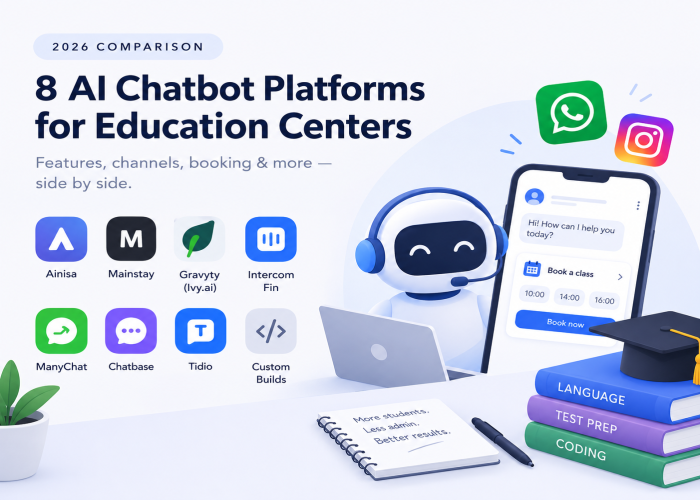
8 Best AI Chatbots for Education Centers & Academies in 2026 — Comparison Guide
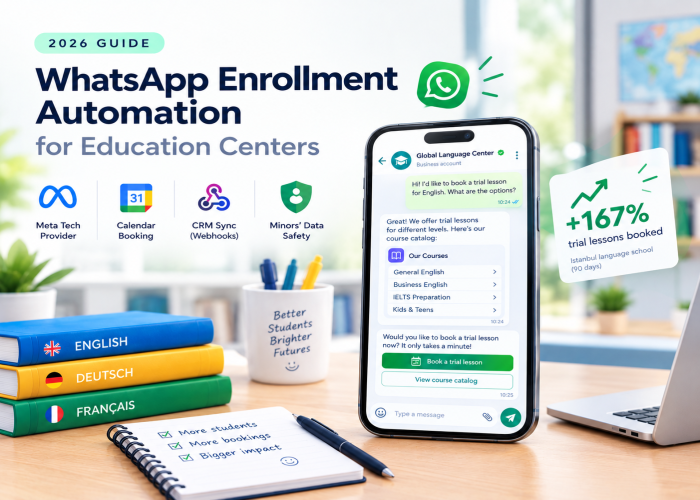
Tutoring centers, language schools, test-prep academies, coding bootcamps, music and art schools, and driving schools all have the same 2026 problem: most new-student inquiries now arrive as a WhatsApp message or an Instagram DM at 9pm, asking "how much is the IELTS course?" or "do you have Saturday classes for my son?" — and if nobody answers within a few minutes, that parent has already messaged the academy down the road.
The gap between "we should automate enrollment inquiries" and "we picked the right chatbot" is bigger than it looks. Most of the platforms that show up when you search "education chatbot" are built for universities — SMS nudging campaigns, financial-aid deflection, enrollment CRMs priced for a campus with 20,000 students and a six-figure budget. A 40-student language school or a three-tutor math center needs something completely different: a bot that answers course and price questions, qualifies the parent or student, and books a trial lesson or consultation — on WhatsApp, in the languages the families actually speak.
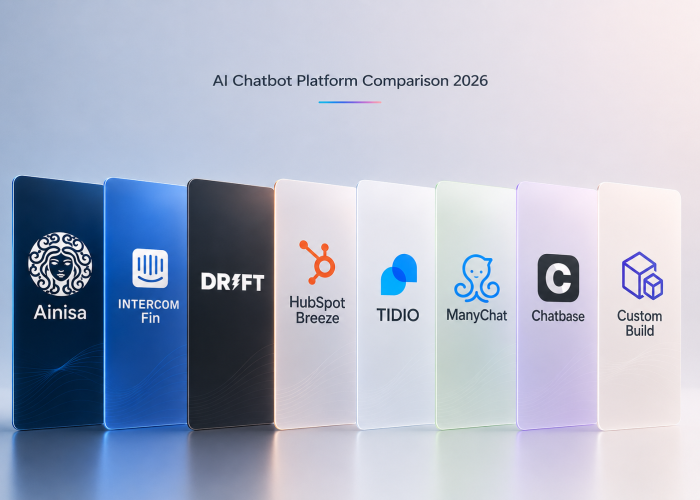
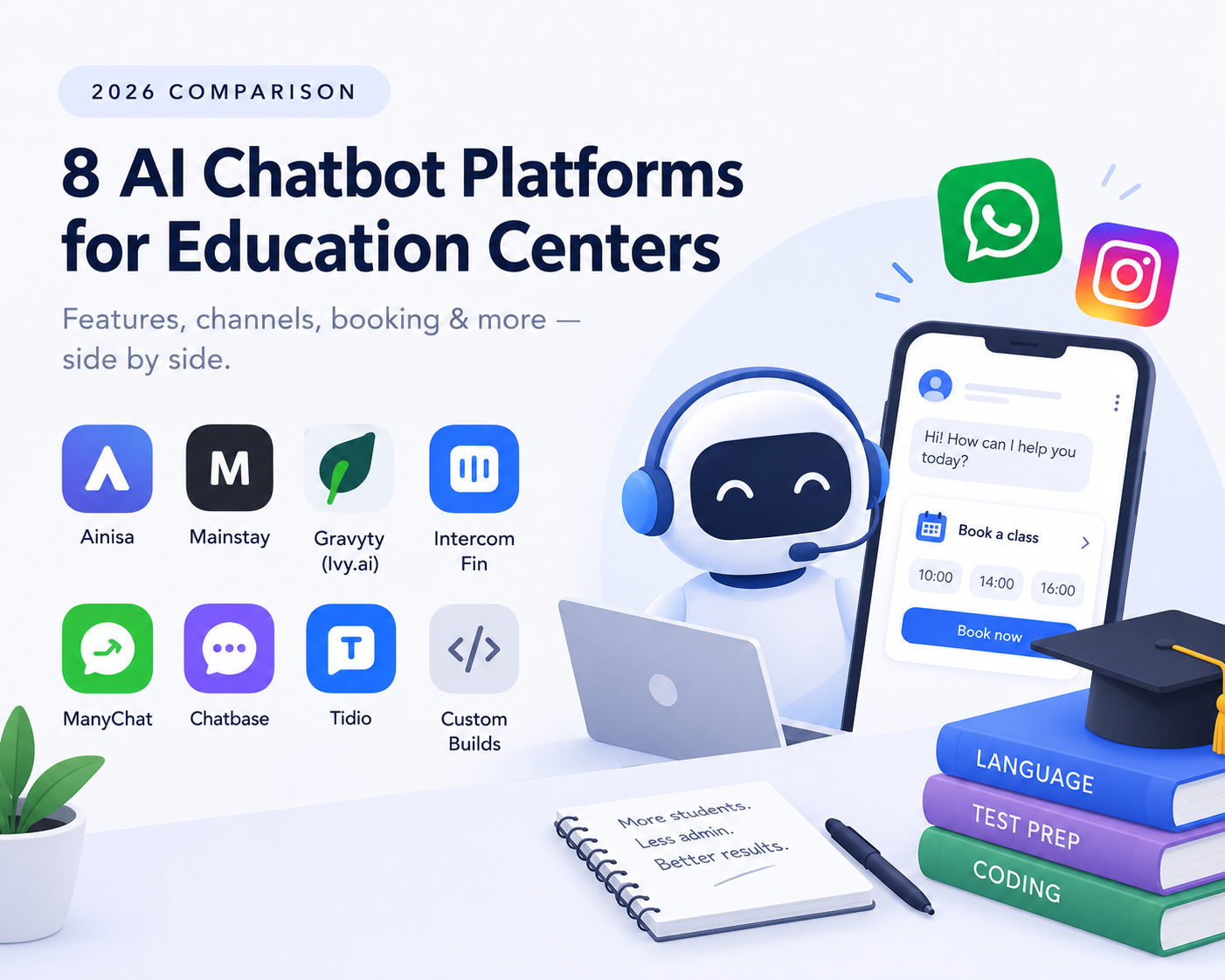
This guide compares 8 AI chatbot platforms that education centers and academies are actually evaluating in 2026 — what each does well, where each falls short, and which fits a small tutoring center vs. a multi-branch language school vs. a large institution. Prices, integrations, and channel support are as of publication and change fast; verify before you commit.
How we compared them
Six criteria, chosen because they're what makes or breaks an education-center deployment:
- Education-center fit — does the platform handle course Q&A, enrollment/trial-lesson booking, and parent-student qualification, or is it a university enrollment CRM that's overkill (and overpriced) for a small center?
- Channel coverage — especially WhatsApp and Instagram — for education centers outside the US, WhatsApp is where parents and students actually message, and Instagram DMs are where teens discover courses. A platform that can't handle both natively is missing most of the modern inquiry flow
- Booking integration — Google Calendar, Calendly, or your scheduling tool. Not through Zapier — natively, so a trial lesson or consultation lands on the right teacher's calendar in the same conversation
- Multi-modal understanding — can it process the voice notes parents send ("my daughter needs help with chemistry before her exam in June"), photos of a report card or a textbook page, or a video? Text-only chatbots miss a lot of education inbound, especially from parents who'd rather talk than type
- Multilingual support — language schools and academies in immigrant-heavy or tourism markets serve families across several languages. The bot has to hold a real conversation in each
- Pricing model & data handling — flat fee vs. per-conversation, UK GDPR / EU GDPR readiness (critical when minors' data is involved), UK or EU data residency, and whether the platform offers BYOK (Bring Your Own Key) or a simple balance top-up — or both
We didn't compare "how smart is the AI" because underneath, most of these platforms call the same underlying models (GPT-4o, Claude, Gemini). What actually differs is the education-specific plumbing around them — and whether the platform is built for a small center's budget or a university's.
Quick comparison table
Verified against each vendor's public documentation and third-party reviews as of publication. Features and pricing tiers change frequently — confirm with the vendor before you commit.
| Platform | Education fit | Booking | Voice/media | Languages | Best for | ||
|---|---|---|---|---|---|---|---|
| Ainisa | ✅ Native education use case | ✅ Meta Tech Provider — connects in minutes | ✅ Native DMs | ✅ Google Calendar + Calendly native, CRM via webhooks | ✅ Voice up to 5 min, photos, videos up to 60 sec | 8 UI langs, AI in many more | Tutoring centers, language schools, academies with WhatsApp/IG inquiries |
| Mainstay (ex-AdmitHub) | ✅ Higher-ed, research-backed | ⚠️ SMS-first | ❌ | ⚠️ Via institution CRM | ⚠️ Text-first | Many | Universities running SMS nudge campaigns |
| Gravyty / Ivy.ai | ✅ Higher-ed, campus-wide | ⚠️ Limited | ⚠️ Limited | ⚠️ Via CRM | ⚠️ Text-first | 100+ | Universities deflecting high FAQ volume |
| Intercom Fin | ⚠️ Support-first, configurable | ✅ Native | ⚠️ Via integration | ⚠️ Via integration | ✅ Voice transcribed on WhatsApp | Many | Large education companies with support teams |
| ManyChat | ⚠️ Marketing-first | ✅ Strong | ✅ Best-in-class | ⚠️ Via Zapier | ⚠️ Limited | Templated | Academies running Instagram/WhatsApp marketing |
| Chatbase | ⚠️ Generic, DIY flows | ✅ Meta Tech Provider, native WhatsApp API | ✅ | ⚠️ Via API/integration | ✅ Voice AI agent (May 2026) | 95+ | Solo tutors, small centers wanting a fast custom bot |
| Tidio | ⚠️ Generic | ✅ Available | ⚠️ Basic | ⚠️ Via Zapier | ⚠️ Limited | ~7 | Small centers wanting cheap website chat |
| Custom build (Voiceflow / Custom GPT) | ✅ If you build it | ✅ DIY via Meta API | ✅ DIY | ✅ DIY | ✅ DIY | Any | Centers with in-house engineers |
A note on this table. The biggest split in education chatbots isn't feature-by-feature — it's who the platform is built for. Mainstay, Gravyty/Ivy.ai, and the enrollment-CRM crowd are excellent for universities and priced accordingly; they're overkill for a tutoring center. The SMB-friendly platforms (Ainisa, Chatbase, Tidio, ManyChat) fit a small-to-mid center's budget and channel mix. Use this as a starting shortlist, then go to each vendor's pricing page and documentation before committing.
The 8 platforms compared
1. Ainisa — best for tutoring centers, language schools, and academies with WhatsApp/Instagram inquiries
Ainisa is a Meta Tech Provider platform built for local service and small-to-mid businesses, with a dedicated education centers & academies use case. Its differentiator in 2026 is the combination of native WhatsApp Business API and Instagram DMs (fast setup, no long Meta verification wait), real multi-modal understanding (voice notes up to 5 minutes, photos, videos up to 60 seconds), and education-specific configuration for course Q&A, enrollment/trial-lesson booking, and parent-student routing.
WhatsApp and Instagram matter here because that's exactly where education inquiries happen in 2026 — a parent WhatsApps at 9pm asking about the exam-prep course, a teenager sees a reel about a coding bootcamp and DMs "how much and when does it start?". If your center can't hold a real, qualifying conversation on those channels, that student enrolls somewhere that could.
What it does well: native WhatsApp Business API through Meta Tech Provider status (connection in minutes, not the day or two of Meta verification most platforms require), Instagram DMs, website widget, Facebook Messenger, TikTok, Telegram — all sharing one knowledge base. Handles course and price Q&A (trained on your course catalog PDF), qualifies the inquiry (which course, which level, student age, schedule preference), and books a trial lesson or enrollment consultation directly into Google Calendar / Calendly. Outbound webhooks push every lead and booking into your own CRM or system in real time. Multi-modal: understands a parent's voice note describing what their child needs, a photo of a report card or a syllabus, or a short video. Product UI in 8 languages; the AI itself converses in many more, so a family can chat in whatever language is most natural to them — which matters enormously for language schools and immigrant-serving academies. UK-registered, UK GDPR-ready with UK data residency (also handles EU deployments) — important when minors' data is in play. Two pricing options: BYOK (pay the LLM provider directly, no AI markup at volume) OR a simple balance top-up (pay Ainisa, no LLM key needed). No-code setup — most centers launch in a day.
Where it falls short: newer than the enterprise giants; brand recognition is smaller. It's not itself a full enrollment CRM — if you need financial-aid workflows, cohort management, or an SIS built into the platform (the way a university system would), a dedicated education-CRM fits that role better. But leads and bookings don't have to stay in Ainisa: outbound webhooks push every captured lead and booking into your own CRM or system in real time, so the AI handles the conversation and your existing tools handle the records.
Pricing: per-conversation on the Meta side plus a monthly platform fee. Two AI-cost options: BYOK keeps AI costs low at volume, or a simple balance top-up if you'd rather not manage a key. Free trial with live demo.
Best fit: tutoring centers, language schools, test-prep academies, coding bootcamps, music/art schools, and driving schools whose inquiries come through WhatsApp and Instagram, who need real course qualification and trial-lesson booking, and who want predictable costs.
2. Mainstay (formerly AdmitHub) — best for universities running SMS nudge campaigns
Mainstay is one of the most established education chatbot platforms, with a genuine research pedigree in behavioral "nudging" — proactive SMS campaigns that improve enrollment, retention, and completion at scale.
What it does well: proven, research-backed proactive engagement; strong at large-scale SMS nudge campaigns (financial-aid reminders, orientation, re-enrollment); deep experience with higher-ed institutions and their metrics.
Where it falls short: built for universities and colleges, not small centers — the pricing and onboarding assume an institution. SMS-first, so it doesn't fit the WhatsApp/Instagram reality of education centers outside the US. Not a fit for a tutoring center or language school that needs course Q&A and trial-lesson booking on WhatsApp.
Pricing: institution-based, quote-only.
Best fit: universities and colleges running proactive SMS engagement at scale.
3. Gravyty / Ivy.ai — best for universities deflecting high FAQ volume
Gravyty (which brought together Ivy.ai and Ocelot) is a campus-wide AI platform focused on question deflection and student engagement across the higher-ed lifecycle, with strong multilingual coverage (100+ languages) and financial-aid-specific tooling.
What it does well: handles enormous FAQ volume across a campus, strong multilingual deflection, financial-aid and student-services depth, mature higher-ed integrations.
Where it falls short: again, this is a university platform — the scope, integrations, and price are built for institutions, not a tutoring center or academy. Channel focus is web and campus systems, not the WhatsApp/Instagram flow small centers live on.
Pricing: institution-based, not publicly disclosed.
Best fit: universities and colleges deflecting high volumes of student FAQs across many departments.
4. Intercom Fin — best for large education companies with support teams
Intercom Fin is a top-tier AI agent for customer support. Larger education companies — edtech platforms, big online course providers, multi-branch chains — that already run Intercom for support often extend Fin to handle enrollment inquiries too. Intercom rebranded itself as Fin in May 2026.
What it does well: excellent conversational AI, strong ticketing and escalation, deep analytics, best-in-class website chat widget. Native WhatsApp integration with automatic voice-note transcription that Fin can read and respond to. Deep CRM integrations.
Where it falls short: not education-specific — course Q&A, enrollment qualification, and trial-lesson booking are all DIY configuration. Enterprise-level pricing that's steep for a small center. Fin's core positioning is customer support, not enrollment — you can configure it for education, but templates and workflows are all support-shaped.
Pricing: tiered seats plus per-resolution fees. Enterprise-level overall.
Best fit: larger edtech companies or multi-branch education chains with an existing Intercom deployment and a support-team culture.
5. ManyChat — best for academies running Instagram/WhatsApp marketing
ManyChat is the incumbent for Instagram and Messenger automation, with strong WhatsApp Business support. Academies and course creators who do heavy inbound marketing on Instagram (language schools, skills courses, personal-brand educators) often use it.
What it does well: Instagram automation is best-in-class — comment-to-DM flows, broadcast campaigns, marketing funnels adapted from e-commerce. Solid WhatsApp for high-volume marketing. Great if enrollment is driven by Instagram content.
Where it falls short: AI understanding is an add-on rather than the core — it grew up as a rule-based flow builder, and the AI layer feels bolted on. Not built for real course qualification (level, age, schedule, goals) — you build those as manual flows. Multi-modal handling is limited. Better for marketing capture than for a genuine qualifying conversation with a parent.
Pricing: tiered by contacts. Gets expensive fast at scale.
Best fit: academies and course creators with heavy Instagram-driven marketing and funnel-style lead capture.
6. Chatbase — best for solo tutors and small centers wanting a fast custom-trained bot
Chatbase lets you upload documents (course catalog, pricing, schedules) and get a chatbot trained on your content in minutes. In 2026 it expanded significantly — 35+ AI models across 7 providers, native WhatsApp Business API (as a Meta Tech Provider), 95+ languages, and (as of May 2026) a voice AI agent via Twilio.
What it does well: fastest time-to-live for a custom-trained bot. Native WhatsApp Business API via Meta Tech Provider status. 95+ languages — genuinely useful for language schools. Voice AI agent for phone inquiries. Model flexibility.
Where it falls short: positioning is primarily customer support, so enrollment qualification and education-specific flows are DIY. Booking integration typically needs API work. Credit-based pricing can spike at high traffic. No dedicated education templates — you're building the education logic yourself on a generic platform.
Pricing: tiered monthly plans on a credit-based model, plus enterprise.
Best fit: solo tutors and small centers that want a smart, multilingual website + WhatsApp bot fast, and are comfortable building the enrollment logic themselves.
7. Tidio — best for small centers wanting cheap website chat
Tidio is a lightweight live chat + basic AI bot, popular with small businesses. Cheap, quick to install, works out of the box on a website.
What it does well: cheap, simple, quick. Fine for a small center that mostly wants a website chat with basic course Q&A and human handoff when a real conversation is needed.
Where it falls short: not built for education. Enrollment qualification is DIY. WhatsApp exists but shallow; Instagram is basic. Multi-modal is limited. Booking mostly via Zapier, which adds lag. Not the tool for a center with serious inquiry volume across channels.
Pricing: cheap tiers, scales with contacts and features.
Best fit: small centers and solo tutors whose main need is a basic website chat.
8. Custom build (Voiceflow / Custom GPT) — best if you have engineering resources and want full control
Not a product exactly — the "build it yourself" option using OpenAI's Custom GPTs, Voiceflow, or a similar low-code AI agent builder, wired to Meta's API for WhatsApp/Instagram and your scheduling tool for booking.
What it does well: complete control over prompts, flows, integrations, and data. No per-conversation markup — you pay only the underlying API calls. If you have specific proprietary enrollment logic, this can fit exactly.
Where it falls short: you're the integrator. WhatsApp Business API onboarding, Meta Tech Provider status, ongoing maintenance, UK GDPR / EU GDPR paperwork (especially with minors' data), and every edge case are on you. Realistic setup is weeks to months, not days. When something breaks at 9pm during peak enrollment season, there's no vendor to call.
Pricing: just the API costs — but engineering time is the real cost.
Best fit: larger education companies with in-house engineering or a technical founder who wants to own the stack.
Head-to-head: what actually matters for education centers
Rather than repeating the criteria per platform, here's how they line up on the things that separate a working education-center deployment from a frustrating one:
Built for a center, or for a university? This is the first fork. Mainstay, Gravyty/Ivy.ai, and the enrollment-CRM platforms are genuinely excellent — for universities, with university budgets and university problems (financial aid, cohort nudging, SIS integration). For a tutoring center, language school, or academy, they're overkill and overpriced. Ainisa, Chatbase, Tidio, and ManyChat fit a small-to-mid center's budget and workflow. Match the tool to your size, not to the longest feature list.
WhatsApp and Instagram, where inquiries actually happen. For education centers outside the US, parents WhatsApp and teens DM on Instagram. Ainisa and Chatbase are both Meta Tech Providers with native WhatsApp — Ainisa on the direct-integration path (connection in minutes), and it also handles Instagram DMs natively. ManyChat is strong on Instagram, good on WhatsApp. Intercom Fin has native WhatsApp. Mainstay is SMS-first; Gravyty is web-first — a real mismatch for centers whose inquiries live on WhatsApp/Instagram.
Course qualification, not just Q&A. A parent messaging "do you do maths?" needs a few follow-ups — what level, what age, exam prep or general support, what schedule — before a trial lesson makes sense. Ainisa has a dedicated education use case configured for this. The others (except the university platforms, which qualify differently) leave you to build the qualification logic yourself.
Multi-modal: voice notes and photos. Parents send voice notes ("she's in year 9 and struggling with algebra before the June exam") and photos (a report card, a textbook page, a timetable). Ainisa handles voice up to 5 minutes, photos, and video up to 60 seconds. Intercom Fin transcribes WhatsApp voice notes. Chatbase added a voice AI agent. ManyChat and Tidio are limited. The university platforms are text/SMS-first.
Multilingual, for real. Language schools and immigrant-serving academies need genuine conversations across languages, not a broken fallback. Ainisa (8 UI languages, AI converses in many more), Gravyty/Ivy.ai (100+, but university-scoped), and Chatbase (95+) are the strongest here. For a language school specifically, this is often the deciding factor.
Minors' data and GDPR. Education centers routinely handle data about children, which raises the compliance bar. Ainisa is UK-registered with UK data residency and handles UK GDPR / EU GDPR cleanly. The university platforms are built with institutional compliance in mind. With ManyChat, Chatbase, and Tidio, verify data residency and how minors' data is handled before you commit.
What to pick, in one sentence
- Tutoring center, language school, or academy with WhatsApp/Instagram inquiries and real course qualification needs: Ainisa.
- Solo tutor or small center wanting a fast, multilingual custom bot they'll configure themselves: Chatbase.
- Small center that just needs a cheap website chat: Tidio.
- Academy whose enrollment is driven by Instagram content and marketing: ManyChat.
- Large edtech company or multi-branch chain with an existing Intercom deployment: Intercom Fin.
- University running proactive SMS engagement at scale: Mainstay.
- University deflecting huge FAQ volume campus-wide: Gravyty / Ivy.ai.
- You have engineers and want full control: custom build — only if it's genuinely a strategic choice, not a way to save money (it usually isn't).
What actually kills an education-center chatbot deployment
Regardless of platform, three things kill deployments faster than any feature gap:
-
Buying a university platform for a small center. The most common and most expensive mistake. A tutoring center signs up for an enrollment CRM built for a 20,000-student campus, drowns in setup, and never launches. Match the tool to your actual size and channels.
-
Not booking anything. A bot that answers "how much is the course?" but can't actually book a trial lesson or enrollment consultation is a fancy FAQ. Whatever platform you pick, wire it into Google Calendar, Calendly, or your scheduling tool from day one — with routing to the right teacher or program.
-
Ignoring WhatsApp and Instagram. If your center's inquiries come on WhatsApp and Instagram (they almost certainly do, outside the US) and your bot only does website chat, you're automating the channel with the least traffic. Start where the parents and students actually message.
Frequently asked questions
Do I need a university-grade platform for a small tutoring center?
Almost never. Platforms like Mainstay, Gravyty/Ivy.ai, and enrollment CRMs are built for institutions — financial aid, cohort nudging, SIS integration, thousands of students. A tutoring center, language school, or academy needs course Q&A, qualification, and trial-lesson booking on WhatsApp and Instagram, at a small-business price. Buying a university platform for a small center is the most common and most expensive mistake in this space.
Can the chatbot really understand voice notes and photos from parents?
Yes, on modern multi-modal platforms. Ainisa, for example, processes voice notes up to 5 minutes, photos, and videos up to 60 seconds, in any of its 8 supported UI languages (the AI converses in many more). A parent sending a voice note "my daughter's in year 9 and struggling with algebra before her June exam" gets a real response that identifies the need and offers a trial lesson — no typing required. A photo of a report card or a timetable is understood as context for booking. The bot never gives an academic assessment from media — its job is to qualify and book, not to evaluate the student.
Does the chatbot need WhatsApp Business API, or is the WhatsApp Business app enough?
You need the WhatsApp Business API. The WhatsApp Business app on a phone doesn't support automation — no AI bot, no calendar integration, no CRM handoff. The API is accessed through a Meta partner; a Meta Tech Provider (like Ainisa) is on the direct-integration path, so connecting takes minutes rather than the day or two most centers expect.
How does it handle inquiries about children — is that a data privacy problem?
Education centers routinely handle minors' data, which raises the compliance bar. Collect only what a trial-lesson booking needs (course, level, age band, schedule, parent contact) — not detailed academic history over chat. Use a platform with proper consent handling and clear data residency: Ainisa is UK-registered with UK data residency and handles UK GDPR / EU GDPR cleanly. For any platform, verify how minors' data is stored and where before you go live.
Can it book a trial lesson directly, or just answer questions?
The whole point is booking. A bot that answers "how much is the course?" but can't book a trial lesson is a fancy FAQ. Choose a platform with native calendar integration (Google Calendar, Calendly) so the AI checks real availability, offers slots, and books in the same conversation — with routing to the right teacher or program. Ainisa books directly into the calendar and pushes the lead/booking to your CRM via webhooks.
Can leads and bookings flow into my existing CRM?
Yes, on platforms with outbound webhooks or native CRM connectors. Ainisa, for example, fires a webhook on every captured lead and every booking, so they land in your own CRM or student-management system in real time — you don't have to log into the chatbot dashboard to see them, and you keep your records where your team already works.
Does it work in the languages our families actually speak?
This is often the deciding factor for language schools and immigrant-serving academies. Depth varies by platform: Ainisa has 8 UI languages with the AI conversing in many more (including mid-conversation language switches), Chatbase supports 95+ languages, and Gravyty/Ivy.ai covers 100+ (but university-scoped). A family that gets a broken fallback in their language usually doesn't enroll — test this specifically with the languages you serve.
How long does it take to launch?
On a modern platform: minutes to connect WhatsApp via a Meta Tech Provider, a few hours to train the AI on your course catalog and pricing, an hour or two to wire up the calendar, and a day of testing across languages, media types, and booking scenarios. Total: about a working day to a week for a solid launch. University-grade platforms take much longer — weeks of institutional onboarding.
What if a parent wants to talk to a real person?
Configure a clear handoff trigger — "human," "teacher," "reception." When triggered, the bot pauses AI replies and alerts your team, and the conversation continues in the same WhatsApp or Instagram thread, so the parent doesn't have to repeat themselves. Also configure automatic handoff for complaints and anything the bot can't answer confidently.
Try one before you commit
Reading a comparison only tells you so much. Every platform on this list has a demo or free trial — actually use them. Send a WhatsApp message asking about a course. Send a voice note describing what a student needs. Attach a photo of a report card. Book a trial lesson. Ask about pricing in a second language. What separates the platforms isn't the feature list — it's how they hold up when you throw real education inbound at them.
Ainisa's Education Centers & Academies AI Agent is live right now — message it on WhatsApp asking about a course, send a voice note describing a student's needs, share a photo, book a trial lesson, or switch language mid-conversation. Every booking lands in a public Google Sheet you can open directly to see what your team would receive. Test the same brain that would run in your center's WhatsApp and Instagram — without connecting anything.
8 supported UI languages, AI converses in many more · Voice notes up to 5 min · Videos up to 60 sec · WhatsApp (Meta Tech Provider) + Instagram + website + Facebook + TikTok + Telegram · Google Calendar + Calendly + CRM via webhooks · Meta Tech Provider · UK GDPR · BYOK or balance top-up · No credit card for trial
More on the same topic:
- How to Set Up a WhatsApp Chatbot for Your Business in 2026 (Step-by-Step) — the WhatsApp side, which matters a lot for education inquiries
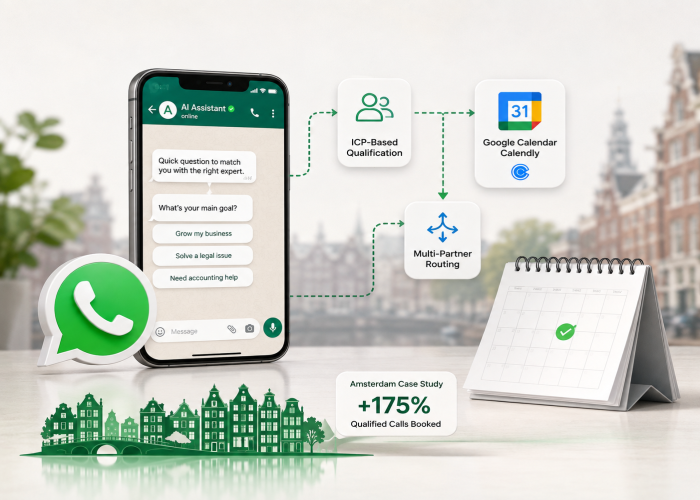
- 8 Best AI Chatbots for Consulting & Professional Services in 2026 — Comparison Guide — parallel comparison in an adjacent service vertical
- 8 Best AI Chatbots for Beauty Salons & Spas in 2026 — comparison methodology in a booking-heavy vertical
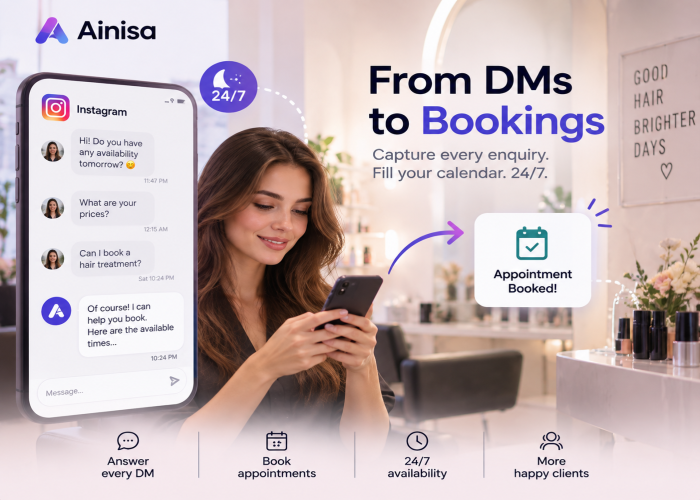
- How Beauty Salons Set Up Instagram DM Automation That Actually Books Clients (2026 Guide) — Instagram DM patterns that also apply to academies
- 8 Best AI Chatbots for Dental Clinics in 2026 — Comparison Guide
- WhatsApp Chatbot for Dental Clinics: 2026 Setup Guide
- 8 Best AI Appointment Booking Chatbots for Medical Clinics in 2026
- 7 Best AI Chatbots for Restaurants in 2026 — Compared
Ainisa also powers AI agents for adjacent verticals:
- 🩺 Medical Clinics — appointments, patient intake, procedure Q&A
- 🦷 Dental Clinics — bookings, insurance intake, patient media handling
- 💇 Beauty Salons & Spas — bookings, service menu, price list
- 🍽️ Restaurants — reservations, menu Q&A, food orders
- 💼 Consulting & Professional Services — lead qualification, discovery calls, client onboarding